-

Fairytale villa : The sweeping lines of the pool and colonnade provide a fluid foreground to views over the city beyond. The planter boxes are from Obbligato in Durban and echo the dome. -
Fairytale villa : The not-so-oval office features cabinetry by Carlos La and silver-leafing by Paintiques. -
Fairytale villa : The step-down shower was kept intact and the same marble inrotoduced elsewhere. The floor and light fixture are last century the Paul Smith towel is not. -
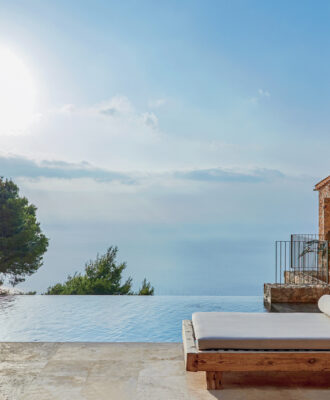
Fairytale villa : Stunning views make the deck the place to be. -
Fairytale villa : Clean lines create spacious luxury. -
Fairytale villa : The tiered garden, dark base and "landscaped" walls settle the imposing building in its site. In time, the podium will disappear in a verdant fringe. -
Fairytale villa : Espresso coloured walls and dark wood panelling abstract the spaces into a series of planes carved from small interleading rooms. -
Fairytale villa : The elaborate ceiling of the wine cellar conceals awkward structure and gives the cylindrical space a surreal feel. -
Fairytale villa : Espresso coloured walls and dark wood panelling abstract the spaces into a series of planes carved from small interleading rooms.


PHOTOS: Greg Cox | PRODUCTION: Etienne Hanekom | WORDS: Haydn Ellis
This Cape Town property hadn’t changed hands in more than 50 years and it took some fancy footwork to wrestle the deal from other parties.
When my clients bought this Cape Town property in 2006, it hadn’t changed hands in more than 50 years – one careful lady owner, as it were – and it took some fancy footwork to wrestle the deal from other parties desperate to own the unexpected weekend listing.
A labour of love
The other projects I have been involved in with them have all been driven by passion but this, clearly, was to be a labour of love and, in the end, I think this is what clinched it. Port Fairypassed from one loving owner to another and immediately there were plans afoot to put some spring into the step of the old girl.
Built in 1926, the original dwelling was apparently the result of an extended study of Palladian villas in Italy. The owner-builder, Senator Whiteside, had lived in that country in the 1920s, was fascinated by these iconic structures and so copied one.
The house reflects Palladio’s style in the rigorous symmetry, grand proportions, cruciform plan and what was then the vogue for cool houses in hot climates: small windows, deep spaces and many rooms. New Age; new order: The Oranjezicht landmark, on its prominent corner site with commanding views of the city, bay and Table Mountain, was about to receive a makeover.
Grande dames are seldom plain sailing and, when the City of Cape Town Urban Conservation Unit and Western Cape Heritage are part of the equation, you know you are in for heavy weather. In truth, the process was a breeze. It was always our intention to enhance rather than alter and, ultimately, red tape rather than resistance took up the time – 12 months – to obtain plan approval.
Still cutting-edge
The defining feature of Port Fairy is its dome and circular colonnade, reminiscent of Washington’s White House and any number of cathedrals. An all-concrete construction that would be considered ambitious even today, it must have been cutting-edge in the suburbs 80 years ago and it still turns heads.
Anybody who has ever tried to furnish round spaces will know that, while unusual and dramatic, they are diabolical to decorate. When the scale of the spaces is modest it is almost impossible, so the early decision to turn what was originally a dysfunctional living room into a study and library was a good one. This became the key that unlocked the rest of the refurbishment.
Old houses are often dark and gloomy and lifestyles have changed over the years so, in order to integrate zones and flood them with light, internal walls were removed and the end of the passage punched through into a tranquil water garden.
Extensions to the master bedroom were added at the back of the house and a staircase dropped into what were previously deep foundations. Accommodation that had been lost in opening up the ground floor was replaced in the basement: two en-suite bedrooms, a home theatre, a staff flatlet, a generous store room and, in the base of the dome, an extraordinary cylindrical wine cellar.
Outdoor areas received similar attention: additional garages and utility spaces were added at the back of the house and the gently sloping site terraced into a series of outside rooms comprising entertainment areas and private courtyards. A new pool and Jacuzzi echo the shape of the dome, while an outdoor barbecue and pool bar duplicate the kitchen and dining room that feed into them.
A “scalloped” wall was raised along the boundary, improving security but not compromising the dwelling’s style and strong street presence. Where high walls were unavoidable, these were pushed back from the pavement to provide a verdant edge to the property. Landscape architects Kobus Meiring and Alan Dawson did a wonderful job planting edges for privacy and layering, as well as shaping a series of off-shutter dwarf walls defining beds, pathways and lawn, which arc away from the base of the house like waves around the prow of a ship.
Preserved and polished
Throughout the build, care was taken to protect original features. Indeed, many of them, such as the ironmongery, ceilings, shutters, certain bathrooms’ fittings, several lights and the lovely bevelled panes of the original doors, were given a good clean and left untouched. Several of the existing finishes were carried through into the extensions, the result a minimal palette of timeless materials that belie the age of the alteration.
In my opinion, the most successful extensions to old buildings do not try and mimic what is already there. Too often, this results in a twee parody that does no justice to the original and leaves it looking cheap. So, as a foil to the period and detailed features of the house, some new elements were treated with a stark minimalism and kept modern.
Bold colours were introduced to abstract what, in some cases, were over-frilly surfaces, while lighting accentuated feature walls, galleries and architectural detail. In some instances, such as the silver-leafing of the study dome’s soffit, we simply abandoned ourselves to excess.
The result is a home that is at once respectful, playful and fresh, with an undeniable glamour. Perfect for the vibrant collection of art and objects it houses and a fitting backdrop to the classic Knoll furniture (available from Tonic Design), with pieces by Eero Saarinen, Eileen Gray, Mies van der Rohe, Harry Bertoia and Massimo Vignelli, to name a few.
This place has the feel of the Hollywood mansions of a bygone era and the presence of a gallery. It is also home to three boisterous dogs and a constant stream of house guests. I have enjoyed cosy suppers there and the poolside summer soirees are the stuff of legend.
It would be easy to diminish Port Fairy as over the top, perhaps a tad overdressed, but I don’t think romance and passion are dead. Unlike most haute designs, she sizes up or down effortlessly and is both comfortable and comforting. In that sense, this unique home is unexpectedly ready-to-wear.
• Haydn Ellis and Associated Architects: 021 422 2824, ellisassociates@iafrica.com
• Kobus Meiring Landscape Architects: 082 453 3654, kobmei@telkomsa.net