-

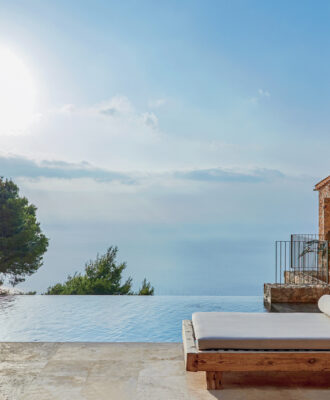
The Incredible Lightness of Being : The living room opens onto a glamorous swimming pool beyond which lies an extraordinary view. The house is a Highveld interpretation of the Californian Case Study Houses built in the mid 20th century. -
The Incredible Lightness of Being : Beams that extend from inside the house to outside and paving that flows from indoor to outdoor living areas ensure that the home enjoys a seamless flow of living space. -
The Incredible Lightness of Being : The study is in the bedroom wing of the house and features custom-made desks and bookshelves designed by Lorinda Kuun from Thomashoff + Partner Architects, adapted by Karin Rooke and built by Koop in Durban. The Eames study chairs are from All Office. -
The Incredible Lightness of Being : The bedroom doors open completely to drink in the view of the Highveld hills. The bedrooms are the only spaces in the house where slate floors were exchanged for soft charcoal carpets. -
The Incredible Lightness of Being : The Rookes’ furniture needs are simple: Almost every piece in the living area and the rest of the house is by Koop, Tonic or Jeremy Stephen Antiques, or an Eames from All Office. -
The Incredible Lightness of Being : The design of this house was a successful collaboration between the owners, Gavin and Karin Rooke, and Pretoria architect Karlien Thomashoff, assisted by Rozanne Basson.


PHOTOS Dook PRODUCTION Greg Gamble WORDS Jacquie Myburgh Chemaly
We featured Gavin Rooke’s Stand 47 – a prototype house for super green, super stylish living built on Monaghan Farm north of Johannesburg – in our May/June 2014 GREENOVATION issue of VISI. Here is Gavin’s own house at Monaghan Farm, arguably the prototype for Stand 47, and inspired by the stripped-down architecture of the Case Study Houses in Los Angeles in the mid 20th century.
Imagine three narrow, white shoe boxes. Now position them to form the capital letter H and you’re starting to see how the new home of Gavin and Karin Rooke took shape.
Recently completed on the Monaghan Farm eco estate north of Johannesburg, the house was designed by Pretoria architect Karlien Thomashoff. Karlien worked closely with the owners who came to the project with one wish in mind: to build a South African interpretation of the legendary Los Angeles Case Study Houses of the 1940s, 50s and 60s.
Gavin Rooke had already designed two family homes himself, so gave the architect a very clear idea of what they wanted. Happily, the two parties saw eye-to-eye on several levels and, most importantly, shared an appreciation of the essence of Modernism – that the function of a house determines its aesthetic.
With architect and client sharing this knowledge of and appreciation for all aspects of Modernism (Karlien’s grandfather was the legendary Pretoria Modernist Philip Nel), it remained for the breathtaking views of the site, on a hillside of the farm, to act as the inspiration for a stripped-down style of architecture so rare on the South African landscape.
Both Karin and Gavin Rooke grew up in Modern homes in Pretoria so there was some nostalgia in their desire to create a Modernist lifestyle for their family of four.
The Case Study House that most inspired their new home was No 18, or Field House, designed by Craig Ellwood. Both houses are clean and simple glass boxes with a glamorous swimming pool dominating the front aspect of the home.
However, with the Rookes’ striking, charcoal slate floors, which flow throughout the house and straight onto the outside living area, their house is firmly rooted in South Africa.
Beams that extend from inside the house to outside, in a series of elegant legs, contribute to the sense that this house sits lightly on its Highveld hill and there is very little separating the interiors from the outdoors.
Once they had chosen the farm site for their house, they literally sat on the hill with three shoe boxes, working out which aspect would give their “Case Study” home the best view and light.
“It’s all about the view,” says Karin, who delights in demonstrating how one can stand outside one length of the H shape and look straight through the house to the other side.
Karlien refers to the house as a piece of “paper architecture” and a “non-roof” house, again emphasising the lightness of the home’s design.
What she calls a non-roof was not a simple procedure, the architect explains, and although you can hardly see it now, it was the trickiest part of the house to construct.
The house is built along a simple grid. One long length of the H shape houses three bedrooms, two bathrooms, a dressing room and a study. All spaces are concealed behind sliding doors that are painted the same unique, grey-white colour as the unplastered walls – thus adding to the seamless flow of the house.
There are no window frames puncturing the glass walls, only louvre windows allowing limitless vistas.
Stripped-down architecture requires meticulous detail and Gavin points to this detail as “moments of sheer genius on behalf of the architect”. There are no skirting boards, carpet trims or even plaster, meaning there was no place to hide and all work had to be perfect.
The other long length of the H is where you’ll find the lounge and dining area, with both lengths opening from floor to ceiling to suck in the exceptional view. A long, welcoming kitchen connects the two lengths and invites visitors in at the front door.
Karin undertook the interiors of the home, working with members of Karlien’s team and Koop Design in Durban to create all the timber work. Almost all the other pieces are from Tonic, Eames or Jeremy Stephen Antiques.
It was important that all the furniture was conceptualised at the time that the house was designed, says Gavin. Nothing was bought after the house was completed.
“For this house to work, we had to know where every piece of furniture was going to go before the house was built.”
The Rookes deliberately avoided dramatic design statements, choosing only complimentary colours and textures that add to the calm flow of the house. Grey linen curtains hang quietly throughout the house. All the furniture is either wooden, grey, black or white and each piece carefully selected to fulfill its functional purpose.
Karin also focused meticulously on consistency: All the lights are black, for example. All the floors are charcoal grey. The only splash of colour is orange. “Repetition makes things easy on the eye,” she says.
Karin also wanted outdoor furniture that would be almost invisible. When she couldn’t find what she wanted, Karin literally drew up her own simple but striking designs with a black, fine-liner khoki and had them made.
A unique aesthetic collaboration between owners and architect, House Rooke is not only an accurate depiction of the Case Study style. It’s also proof that when knowledge and personal passion are made manifest, the result just works.
Karlien Thomashoff, Thomashoff + Partner Architects, 012 341 4508 or karlien@thomashoffstudio.co.za
Read about Gavin’s even more eco Monaghan Farm prototype, Stand 47, in our May/June 2014 GREENOVATION issue of VISI.
See more Monaghan Farm homes here.